


Piston-diaphragm pumps for abrasive slurries, mine water, and demanding pumping applications
In the mining and raw materials industries, pumps are often required to handle fluids that are abrasive, contain solids, or have varying compositions. Therefore, the decisive factor is not only the type of fluid being pumped, but also the conditions under which the pumping process operates.
Emmerich designs each pump solution specifically for the application at hand: the fluid being pumped, solids content, flow rate, pressure, head, distance, temperature, and process environment determine which pump technology makes the most sense from both a technical and economic standpoint.
Not every mining application requires a piston-diaphragm pump. Its strengths lie primarily in situations where challenging fluids, higher pressures, longer distances, or high demands on operational safety and service life converge.
When is a piston-diaphragm pump a good choice for mining?
Piston-diaphragm pumps are particularly useful when abrasive, solids-laden, or chemically aggressive fluids need to be pumped in a controlled manner. This technology also demonstrates its advantages when dealing with greater heads, longer distances, or higher pressures.
For simple applications involving very large volumes of water and low pressure, however, a piston-diaphragm pump is not automatically the most economical solution. In such cases, other pump types may be more suitable. Emmerich therefore evaluates each application individually and does not recommend a standard, off-the-shelf solution.
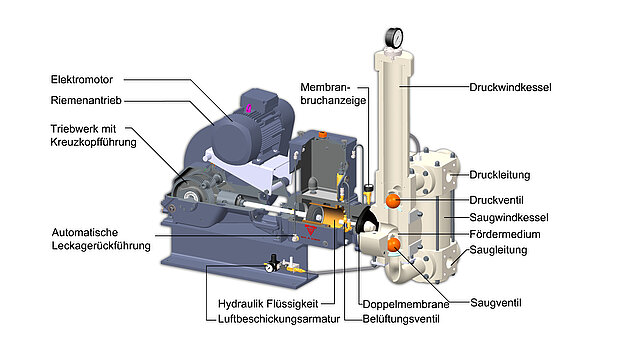
Why Piston-Diaphragm Pumps Are Suitable for the Mining and Raw Materials Industries
In mining and raw materials applications, pumps often have to handle abrasive, solids-laden, or media with varying compositions. Such applications require robust pump systems that not only achieve the required flow rate but are also suited to the actual operating conditions.
In a piston-diaphragm pump, the diaphragm separates the pumped medium from the hydraulic system. As a result, abrasive or contaminated media do not come into direct contact with central drive components. This supports safe and predictable plant operation.
The pump head, valves, diaphragm, and other components in contact with the fluid are selected to suit the specific fluid, solids content, particle size, abrasiveness, flow rate, pressure, and delivery distance. The result is a pump solution designed for the actual process—not for a generic, standard application.
Piston diaphragm pumps can particularly demonstrate their advantages in applications involving greater lift heights, longer distances, higher pressures, or a high risk of wear. Whether the technology is suitable for a specific application is determined by analyzing the complete operating data.
Why Emmerich for the mining and raw materials industries?
It is not just the pumping principle that determines a reliable pumping process. What matters most is how precisely the pump is tailored to the fluid, solids content, pressure, pumping distance, and system conditions. Emmerich combines more than 80 years of experience with a high degree of vertical integration and customer-specific material selection.
- High pressures beyond the range of many conventional transfer pumps
- Reliable handling of abrasive slurries and suspensions
- Solutions for media containing solids and with varying compositions
- Design tailored to flow rate, pressure, head, and discharge distance
- High efficiency and cost-effective plant operation
- Low wear and long service life thanks to appropriate material selection
- Custom combinations of pump, diaphragm, and valve materials
- Development and manufacturing “Made in Germany”
The result is not a standard pump, but a solution tailored to the process with the goal of permanently reducing downtime, wear, and maintenance costs.
What Factors Determine Pump Design
When sizing a pump for use in the mining and raw materials industries, it is not enough to consider only the flow rate and pressure. The properties of the fluid, the solids content, and the specific delivery distance must also be taken into account.
| Design Factor | Technical Significance | Impact on the Pump Solution |
|---|---|---|
| Pumped medium | Slurry, suspension, mine water, or process fluid | Selection of pump head, diaphragm, valves, and materials |
| Solids content | Proportion, size, and nature of the particles contained | Design of valve technology, flow cross-sections, and wear protection |
| Abrasiveness | Mechanical stress caused by mineral or hard components | Determination of suitable components in contact with the medium and service life reserves |
| Flow rate | Required volumetric flow rate during operation | Sizing of pump, drive, and control system |
| Discharge pressure | Required pressure based on the process, head, and piping | Selection of the pressure range and verification of mechanical stress |
| Piping run | Length, elevation differences, piping, and installation conditions | Consideration of piping losses and operational safety |
| Operating mode | Continuous operation, batch operation, or varying load conditions | Adaptation of control, regulation, and design to the plant process |
| Plant environment | Installation, accessibility, control, and existing process peripherals | Adaptation to installation, maintenance, operation, and technical integration |
The specific design depends on the conveyed medium, its solids content, abrasiveness, the desired flow rate, the required pressure, the conveying distance, and the existing plant environment.
Typical Conveyed Materials
- Abrasive slurries
- Mineral suspensions
- Process slurries
- Mine water under difficult pumping conditions
- Coal slurry
- Liquids containing solids
- Chemically contaminated process media
- Media with varying solids content
- Residues from processing and dewatering
- Suspensions from raw material processing
Typical Applications
- Conveying abrasive slurries and suspensions
- Hydraulic transport of media containing solids
- Pumping over long distances or to great heights
- Pumping applications requiring higher pressure
- Feeding filter presses in raw material processing
- Dewatering processes involving challenging media
- Transport of mineral suspensions
- Conveying process media with a high risk of wear
- Controlled pumping under varying media conditions
Which pumps are suitable for the mining and raw materials industries?
That depends on the fluid being pumped and the operating conditions. Piston-diaphragm pumps may be a good choice for abrasive slurries, fluids containing solids, longer pumping distances, or higher pressures. The decisive factors are the fluid, solids content, flow rate, pressure, pumping distance, and the process being carried out.


Frequently Asked Questions About Pumps for the Mining and Raw Materials Industries
That depends on the fluid being pumped and the operating conditions. Piston-diaphragm pumps may be a good choice for abrasive slurries, fluids containing solids, longer pumping distances, or higher pressures. The key factors are the fluid, solids content, flow rate, pressure, pumping distance, and the process being carried out.
No. For simple pumping applications involving very large volumes and low pressure, other types of pumps may be more cost-effective. Piston-diaphragm pumps are particularly suitable when difficult-to-handle fluids, higher pressures, longer distances, or high requirements for operational reliability and service life are all factors.
Yes, provided the pump is properly designed for the fluid, solids content, particle size, abrasiveness, flow rate, pressure, and operating mode. The components that come into contact with the fluid must be selected to withstand the abrasive properties of the fluid in order to reduce wear and downtime.
Key factors include the fluid being pumped, solids content, particle size, abrasiveness, temperature, desired flow rate, required pressure, delivery distance, head, piping, and operating mode. These factors determine which pump solution is technically and economically suitable.
Such applications can be evaluated once specific operating data is available. The key factors are not only the name of the medium, but also its composition, solids content, abrasiveness, pressure range, and conveyance distance.
The diaphragm separates the pumped medium from the hydraulic system. This is important for abrasive, solids-laden, or contaminated media because it protects key drive components and allows the parts in contact with the medium to be specifically designed for the process.
The choice of materials affects service life, wear behavior, and operational reliability. The pump head, diaphragm, valves, and other components that come into contact with the fluid are selected based on the fluid, solids content, abrasiveness, and chemical exposure.


