


Reliably Convey Abrasive Materials and Minimize Downtime
Pumps used in mining and in sand and gravel plants operate under conditions in which wear and equipment availability directly determine the economic viability of the process. Slurries, high solids content, and abrasive components place a strain on the pump head, diaphragm, and valve system over long periods of operation.
Emmerich designs piston-diaphragm pumps specifically for the particular fluid being pumped and the actual operating conditions. Factors taken into account include solids content, particle size, flow rate, pressure, delivery distance, head, temperature, and operating mode.
The goal is not merely to achieve the required flow rate. What is crucial is a stable process, predictable service life, and the lowest possible costs for maintenance and unplanned downtime.
When Solids, Abrasiveness, and Continuous Operation Come Together
In raw material processing, pumps often have to handle media whose composition and abrasive effects are significantly more demanding than those of pure liquids. It is not merely a matter of whether a medium is fundamentally pumpable. Solid content, particle size, density, viscosity, and abrasiveness all influence the overall design.
In mining, finely ground ores can be mixed with water to form a flowable suspension and transported for processing or further treatment. In sand and gravel plants, the pumping task may involve returning non-recyclable materials from extraction back to the mining area.
An inappropriate pump design can lead to increased component wear, unstable flow, more frequent maintenance calls, and unplanned process interruptions. Especially in continuous operation, the flow rate, material selection, and system conditions must therefore be considered together.
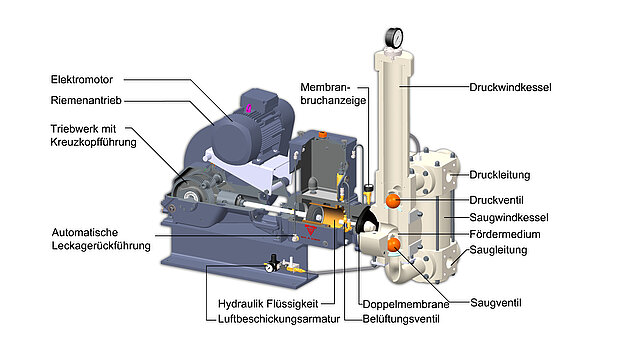
Why Piston-Diaphragm Pumps May Be Suitable for Abrasive Suspensions
In a piston-diaphragm pump, the drive mechanism and the pumped medium are separated from one another. The medium is guided in a controlled manner through the pump head, while the mechanical drive components do not come into direct contact with the suspension.
For abrasive fluids, however, the pumping principle alone is not the decisive factor. The pump head, diaphragm, valves, materials, and flow cross-sections must be suited to the fluid, the particle size, and the desired operating point. Only this careful coordination makes the pump technology a reliable solution for the specific process.
The positive displacement principle and high efficiency can be particularly economically significant under demanding pressure conditions and during long operating times. For long delivery distances or significant delivery heads, the entire piping layout is also factored into the design.
The existing technology confirms the separation of the drive from the medium, suitability for use with abrasive media, and the ability to customize the pump head, valves, and control system.
Factors Considered in the Design
A suitable pump solution is not based on a standard configuration, but rather on the specific operating data of the process. For applications in mining as well as in sand and gravel plants, Emmerich takes the following factors into particular consideration:
- the composition, solids content, and particle size of the medium
- Abrasiveness, density, viscosity, and temperature
- Flow rate, discharge pressure, delivery distance, and head
- Suitable materials, diaphragms, valves, and flow cross-sections
- Requirements for control systems, variable-frequency drives, and plant control
- Maintenance requirements, service life, wear risks, and operating costs
What factors determine the pump design?
When designing a reliable pump, it is not only the flow rate and pressure that are considered. The properties of the fluid, the piping, and the intended operating conditions also influence which pump design is technically and economically suitable.
| Design Parameter | Relevance to Pump Design |
|---|---|
| Pumped Fluid | Composition, density, viscosity, and chemical properties determine the basic design of the pump. |
| Solids Content | The solids content affects the pumping performance, the stress on the components, and the required pump capacity. |
| Particle Size and Abrasiveness | Particle size and abrasiveness are relevant to valve design, flow cross-sections, and material selection. |
| Flow rate | The required flow rate, together with the discharge pressure, defines the required operating point. |
| Discharge pressure | The required pressure is determined by the process, the delivery head, and the resistance within the piping. |
| Piping Run and Head | Length, elevation differences, pipe diameter, and the layout of the piping system influence the system’s pressure requirements. |
| Temperature | The fluid temperature is relevant for selecting the diaphragm, seals, and materials in contact with the fluid. |
| Suction Conditions | The suction head or available inlet head must be taken into account to ensure that the pump is reliably supplied with fluid. |
| Operating Mode | Continuous operation, load cycling, and scheduled operating times affect the drive, control system, and maintenance plan. |
| Control and regulation | Mechanical control, variable-frequency drives, or process control are tailored to the desired operating sequence. |
The more precise this information is, the more reliably the technical suitability, potential wear risks, and expected operating costs can be assessed.
Typical Conveying Applications in the Raw Materials Industry
In mining, as well as in sand and gravel plants, different pumping tasks arise depending on the extraction and processing methods. In addition to transporting flowable ore suspensions, other tasks include recirculating solids-laden tailings or supplying media for downstream process steps.
Which pump solution is suitable does not depend solely on the industry. The decisive factors are the composition of the fluid, the pumping distance, the required pressure, and the intended operating mode.
Sand, Gravel Pits, and Mining
- Return transport of non-recyclable materials to the mining site
- Conveyance of solids-laden residues from extraction
- Process water recirculation, provided the medium and process conditions are suitable
- Conveyance of flowable ore suspensions
- Transport to processing or further processing facilities
- Tailings transport
- Concentrate conveyance
Hydraulic transport over longer distances and at greater lifting heights
When abrasive or solids-laden suspensions must be continuously transported through long pipelines or over significant elevation differences, the focus shifts to the entire pumping system. The pumping distance, head, pipeline losses, fluid, and desired flow rate collectively determine the required pressure.
To learn how Emmerich designs such conveying processes and what economic advantages piston-diaphragm pumps can offer under demanding pressure conditions, visit the page on hydraulic conveyance.
Dewatering of Process Slurries Using Filter Presses
If dewaterable process sludge is generated during extraction or processing, feeding the filter press can be a separate downstream process step. In this case, the pump does not primarily need to overcome a long delivery distance, but rather must adjust its flow rate to the increasing press pressure during the filtration process.
For more information on automatic pressure and flow rate adjustment as well as cost-effective feeding, please visit the page on filter press feeding.


Frequently Asked Questions About Piston-Diaphragm Pumps for Mining, Sand, and Gravel Plants
For abrasive slurries and suspensions containing solids, pumps should be selected whose components in contact with the fluid are designed to handle the solids content, particle size, and wear effects. Piston-diaphragm pumps may be suitable for such processes if the pump head, diaphragm, valves, and operating point are properly designed.
In general, piston-diaphragm pumps can handle media containing solids. Their specific suitability depends, among other factors, on the solids content, particle size, density, viscosity, abrasiveness, and flow rate. A general load limit should not be specified without media data.
Hydraulic transport is the primary method when a slurry is continuously conveyed through a pipeline, and the distance, head, and pipeline losses determine the required pressure. For such projects, the design should be explored in greater detail on the “Hydraulic Transport” page.
Tailings transport and concentrate conveyance are listed as typical applications on the existing "Applications" page. Whether a specific pump is suitable is determined based on the fluid, solids content, particle size, flow rate, and plant conditions.
We require as precise information as possible regarding the pumped medium, solids content, particle size, density, viscosity, temperature, flow rate, pressure, conveyance distance, head, suction conditions, and operating mode.


