


Efficiently conveying liquids and suspensions over distance and elevation
In hydraulic transport, the delivery distance, delivery head, and pipeline losses determine the pressure a pump must maintain over the long term. If the fluid being pumped also contains solids or abrasive components, the requirements for wear resistance and operational reliability increase as well.
Emmerich develops piston-diaphragm pumps and custom pump systems for demanding industrial pumping processes. The design is based on the fluid, the desired flow rate, the delivery distance, the head, and the actual operating conditions.
The goal is not merely to achieve the required flow rate. What is crucial is a stable process, predictable service life, and economical operation over the entire service life.
When the conveying distance, head, and medium interact
The required pump capacity for hydraulic transport cannot be determined solely by the desired flow rate. As the length of the piping increases, piping losses occur. In addition, any existing difference in elevation must be overcome. This, together with the process requirements, determines the necessary discharge pressure.
For media containing solids or abrasive media, the pump design must simultaneously take into account how the medium is conveyed through the system and the wear it causes on components in contact with the medium.
For operators, this means that a technically adequate pump is not automatically an economical pump. Energy consumption, wear, maintenance intervals, and process stability must all be considered together.
Why Piston-Diaphragm Pumps May Be Suitable for Hydraulic Transport
Piston-diaphragm pumps operate on the positive-displacement principle and may therefore be particularly suitable for applications where defined flow rates must be maintained against elevated system pressures.
In hydraulic transport, the advantage lies not solely in the achievable pressure. The decisive factor is the interplay of flow rate, efficiency, fluid, and operating mode.
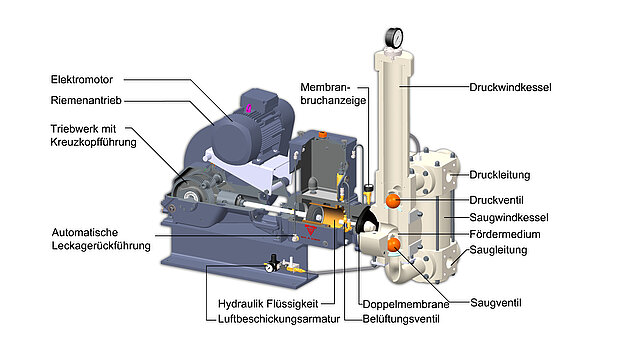
In a piston diaphragm pump, the pumped medium is separated from the mechanical components of the drive. As a result, when properly designed, the pump can handle media containing solids, abrasive substances, or highly corrosive chemicals.
Emmerich determines which design is suitable on a project-by-project basis. The pump head, materials, diaphragms, drive, and, if necessary, the control system are tailored to the actual operating conditions.
Cost-effectiveness is demonstrated over many hours of operation
In continuous hydraulic transport, even small differences in energy consumption can have a significant impact on operating costs over the course of a year. At the same time, abrasive particles in the fluid affect service life and maintenance requirements.
An economical pump design therefore considers more than just the purchase price.
The following factors are particularly relevant:
- Energy consumption at the actual operating point
- Efficiency of the pump system
- Wear caused by the pumped medium
- Service life of components in contact with the fluid
- Maintenance requirements
- System availability
- Stability of the continuous pumping process
Thanks to its application-specific design, the pump is tailored not to a theoretical maximum value, but to the actual requirements of the system.
What factors determine the pump design?
When designing a hydraulic transport system, the entire system must be taken into account. The following information helps determine the required operating point and a suitable pump model.
| Design Parameter | Significance for Pump Design |
|---|---|
| Pumped medium | Determines, among other things, the materials, pump head design, and requirements for components in contact with the fluid. |
| Solids content | Affects pumping performance, wear, and the pump’s technical design. |
| Flow Rate | Determines the volumetric flow rate that must be continuously supplied to the process. |
| Piping run | Affects pipeline losses and thus the required discharge pressure. |
| Head / Elevation difference | Must be overcome in addition to the losses in the piping system. |
| Required pressure | Is determined by the overall hydraulic system and plays a key role in determining the appropriate pump design. |
| Temperature | Is relevant, among other things, for material selection and the design of components in contact with the fluid. |
| Operating Mode | Continuous operation, load cycling, and desired controllability influence the design of the entire pump system. |
Not all process data needs to be fully determined at the outset. Emmerich assists with the technical evaluation and designs the pump solution based on the available plant and fluid data.
Typical Fluids and Requirements for Hydraulic Transport
Hydraulic transport becomes particularly challenging when, in addition to long conveying distances or significant head, the difficult properties of the medium must be taken into account. Emmerich focuses on industrial applications where standard solutions reach their technical or economic limits.
Hydraulic Conveyance as Part of Industrial Process Chains
In industrial plants, hydraulic transport often connects spatially separated process steps. The fluid must not only be moved from one tank to the next; the flow rate and pressure must also be designed to ensure a reliable supply to the subsequent process.
This is why a precise system analysis becomes particularly important in cases involving long pipelines or significant differences in elevation. The piping, fluid, and pump cannot be evaluated independently of one another.
In the case of abrasive or solids-containing media, a high flow rate alone is not sufficient. The solution must also be suitable for continuous operation from a wear-resistance perspective.
Suitable piston-diaphragm pumps for hydraulic transport
The specific Emmerich piston-diaphragm pump suitable for a hydraulic transport process is determined based on the specific process data. Flow rate, required pressure, fluid being pumped, solids content, temperature, and the system environment all influence the selection.
Emmerich offers various model series as well as custom-designed special versions. It is therefore not practical to assign specific models to hydraulic transport on a blanket basis.


Frequently Asked Questions About Hydraulic Transport
The appropriate pump is not selected based solely on the length of the pipeline. The delivery distance, pipeline losses, head, flow rate, and properties of the fluid collectively determine the required operating point. For high-pressure applications and media that are abrasive or contain solids, piston-diaphragm pumps may be suitable for such pumping processes.
As the difference in elevation increases, so does the pressure that the pump system must overcome in addition to the pipeline losses. To ensure a robust design, therefore, both the delivery distance and the delivery head are taken into account.
Yes. Emmerich also designs piston-diaphragm pumps for media containing solids and abrasive media. Key factors include the solid content, the properties of the medium, the flow rate, the pressure, and the operating mode.
Hydraulic transport processes often run for long periods of time. Energy consumption therefore has a direct impact on operating costs. In addition to the technical flow rate, it is therefore important to consider how efficiently the pump operates at its actual operating point.
It is helpful to provide information on the fluid to be pumped, the solids content, the desired flow rate, the discharge distance, the head, the temperature, and the operating mode. If the required pressure is already known, this should also be specified. Based on this data, the appropriate pump model can be evaluated.


