


Reliable conveyance of aggressive and abrasive media
Aggressive chemicals, abrasive suspensions, and the highest safety requirements place special demands on pump systems. Emmerich’s piston diaphragm pumps were developed specifically for these applications. They handle demanding fluids safely and economically—even where conventional pump technologies reach their limits.
The diaphragm reliably separates the pumped medium from the hydraulic system. Materials, the diaphragm, valves, and pump head are selected to match the medium, concentration, temperature, and solids content. This results in a pumping solution that reliably supports the process and reduces unplanned downtime.
Have a pump designed for chemical and electroplating applications
When aggressive media require the highest level of operational safety
Chemical pumping processes often involve multiple requirements at the same time: The fluid may be corrosive, contain abrasive solids, change in viscosity, or be pumped at elevated temperatures. In electroplating plants, sensitive bath compositions and strictly defined process conditions are additional factors.
Selecting an unsuitable pump leads not only to technical wear and tear. For operators, it means potential product leaks, unplanned downtime, more frequent maintenance, and rising operating costs. That is why the pumped medium, concentration, temperature, solids content, flow rate, pressure, and material compatibility are all considered together.
Emmerich tailors the pump solution to the actual operating point and the fluid. This ensures predictable service life, reduces maintenance risks, and supports safe plant operation.
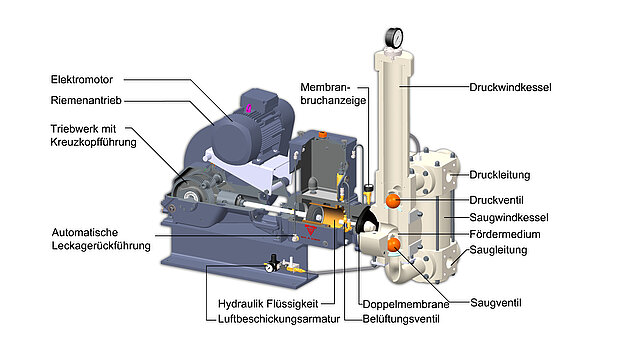
Why Piston-Diaphragm Pumps Are Suitable for Chemically Corrosive Fluids
In a piston-diaphragm pump, the diaphragm separates the pumped medium from the hydraulic system. As a result, the medium does not come into contact with the piston, cylinder liner, or hydraulic fluid. This reduces the risk of product leakage and ensures safe plant operation.
The pump head, valves, diaphragm, and other components in contact with the fluid are selected to suit the chemical composition, concentration, temperature, and solids content. Depending on the application, materials such as PPH, PVDF, or stainless steel, as well as various diaphragm materials, may be used.
This allows even highly corrosive liquids, abrasive suspensions, and media containing solids to be reliably pumped. The appropriate combination is determined based on the complete operating data.
Why Choose Emmerich for Chemistry and Electroplating?
It is not just the pumping principle that determines whether a process is safe and economical. What matters most is how precisely the pump is tailored to the fluid, pressure, solids content, and system conditions. Emmerich combines more than 80 years of experience with a high degree of vertical integration and customer-specific material selection.
- High pressures beyond the range of many conventional chemical pumps
- Reliable handling of abrasive suspensions
- Solutions for media containing solids
- High efficiency
- Low wear and long service life
- Custom combinations of pump, diaphragm, and valve materials
- Development and manufacturing “Made in Germany”
The result is not a standard pump, but a solution tailored to the process with the goal of permanently reducing downtime and maintenance costs.
What Factors Determine Pump Design
When sizing a pump for use in the chemical and electroplating industries, it is not enough to consider only the flow rate and pressure. The properties of the fluid and the specific operating conditions must also be taken into account.
| Design Factor | Technical Significance | Impact on the pump solution |
|---|---|---|
| Pumped medium | Chemical composition and type of fluid | Selection of materials and components in contact with the fluid |
| Concentration | Severity of chemical exposure | Testing the resistance of the pump head, diaphragm, valves, and seals |
| Temperature | Thermal stress during operation | Impact on material selection, diaphragm design, and structural configuration |
| Solid content | Proportion, size, and nature of the particles present | Design of valve technology, flow cross-sections, and components subject to wear |
| Flow rate | Required volumetric flow rate in the respective process step | Determination of pump size, stroke rate, and operating mode |
| Discharge pressure | Required pressure at the intended operating point | Selection of series, drive, and pump configuration |
| Operating mode | Continuous, intermittent, or process-dependent operation | Coordination of sizing, regulation, and control |
| System integration | Piping, connections, control system, and existing process environment | Adaptation to technical integration and the higher-level plant control system |
The specific design depends on the pumped medium, its concentration and temperature, any solids present, the desired flow rate, the required pressure, the operating mode, and the existing plant environment.
Typical Applications
- Pumping of electroplating wastewater
- Transfer of chemical liquids between tanks and process stages
- Pumping of electrolyte and anodizing slurries
- Transport of metal-containing suspensions
- Feeding filter presses with chemical slurries
- Pumping of acids and alkalis
- Controlled conveyance of process solutions
- Conveying chemical media containing solids
Pumps Suitable for the Chemical and Electroplating Industries
Depending on the fluid being pumped, material requirements, flow rate, pressure, and system environment, various Emmerich pump solutions may be suitable. The selection should not be based solely on a specific series, but rather on the complete operating data.


Frequently Asked Questions About Pumps for the Chemical and Electroplating Industries
When it comes to chemically aggressive liquids, the type of pump alone is not the deciding factor. The materials in contact with the fluid, the diaphragm, the valve technology, as well as the temperature, concentration, and discharge pressure must be compatible with the fluid. Piston-diaphragm pumps can be suitable for such applications if they are properly designed.
Acids and alkalis are among the applications. Whether a specific liquid can be pumped depends, among other things, on its composition, concentration, temperature, and the required materials. This information is reviewed prior to design.
In a piston-diaphragm pump, the diaphragm separates the pumped fluid from the mechanical drive components. This is important for critical fluids because the fluid-contacting side of the pump can be specifically designed to withstand the chemical properties of the fluid.
Chemical suspensions have been confirmed as a typical application. The design must take into account the solids content, particle size, abrasiveness, viscosity, flow rate, and pressure.
Depending on the pump model, the output can be controlled mechanically, electronically, or via a variable-frequency drive and integrated into a process control system. The appropriate control method depends on the process sequence and operating point.
In particular, we need information on the medium, concentration, temperature, solids content, flow rate, discharge pressure, operating mode, piping, and system control. If safety data sheets are available, please include them with your submission.


